Module 1 of 4Blockchain Technology

How a blockchain records, agrees, connects and settles, taught as a reading skill. By the lab, your team can judge a multi-chain proposal without reading a line of code.

  • 3 sessions
  • About 6 hours
  • Beginner to intermediate
  • Online or in person

Outcomes

By the end of the module, you can

  1. Explain in plain English how a blockchain records, agrees and finalises a transaction.
  2. Tell public, permissioned and sidechain setups apart by who can join and who decides.
  3. Show why bridges and stablecoins are where connection risk concentrates.
  4. Say what a token holder actually owns and what the smart contract decides on their behalf.
  5. Judge where blockchain creates value in banking, insurance and capital markets.
  6. Apply five setup questions to a live proposal and defend a recommendation as a team.

Sessions

Two sessions to build it. One lab to use it.

Session 1120 minutes, virtual-live

Blockchain foundations

A plain-English model of the shared ledger, then the three questions that decide most risk: who runs it, how it agrees, and what it connects to.

  1. Shared ledger, transaction journey and wallets
  2. Consensus mechanisms, finality and trade-offs
  3. Public, permissioned and sidechain design choices
  4. Interoperability: bridges and wrapped assets
  5. Stablecoins: what backs the promise
  6. Commitments and the five setup questions
Session 2120 minutes, virtual-live

Tokens, smart contracts and use cases

What rides on the chain, who controls the code, and where value is really created.

  1. Token standards: what a holder owns
  2. Smart contracts and the two questions to retain
  3. Use case: banking and lending
  4. Use case: InsurTech and parametric cover
  5. Use case: capital markets and asset management
  6. Guided use-case exploration
Session 3120 minutes, virtual lab

Application lab: Meridian Extension Review

Teams take the five setup questions to Meridian's full file and recommend whether the extension advances.

  1. Briefing, roles and the pack
  2. Phase 1: who runs it, and how does it agree?
  3. Phase 2: what does it connect to?
  4. Phase 3: what is the asset, and what controls the code?
  5. Phase 4: recommend and defend
  6. Debrief: four lessons

Lab spotlight

Meridian Extension Review

Meridian Digital Capital wants to scale its tokenised trade receivables pilot tenfold, from about 40 invoices a month to 400, across Ethereum, Polygon and BNB Chain. Buyers settle in USDC, a bridge mirrors the tokens, and an upgradeable escrow contract holds the money until delivery is confirmed.

  • Advance
  • Advance with conditions
  • Do not advance

What teams do

  • Read a four-document pack: technical summary, contract roles annex, audit report cover and a comfort letter.
  • Fill a network grid for three chains: who validates, who changes the rules, finality, confidence.
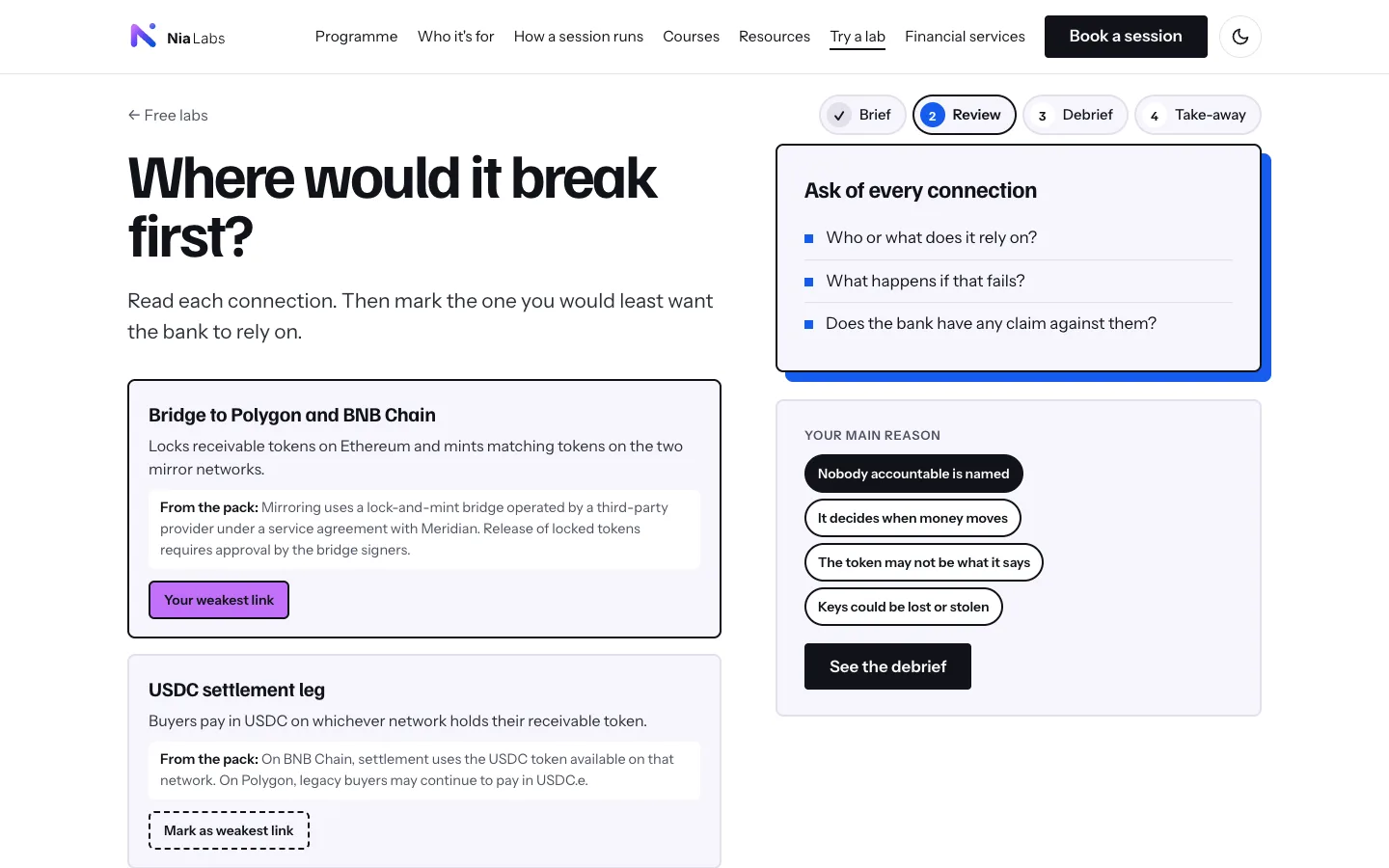
  • Map four connections, rate each one and name the weakest link.
  • Absorb injects mid-lab, such as Meridian finally naming its bridge operator.
  • Present in three minutes, then take two minutes of challenge.
The weakest-link screen: four connections in Meridian's pilot, one marked as the weakest link
Naming the weakest link in Meridian's pilot in the public taster. The full lab rates every network and connection, adds the token and contract phase, and brings in live replies from Meridian.

Four roles per team

  • Setup AnalystOwns the reading sheet and the evidence behind each answer.
  • Connections AnalystOwns the connection map and the weakest-link finding.
  • Risk and Audit ChallengerTests evidence quality and asks the smart contract questions.
  • Decision OwnerSynthesises the team view and presents the call.

What the debrief draws out

  • You can read a setup without reading code.
  • Risk concentrates at the joins.
  • “Undisclosed” is an answer.
  • Control is a governance question.

Who it is for

A cross-functional room, on purpose.

No coding background needed. The module works best with Risk, Compliance, Audit and Technology in the same breakout.

Risk, Compliance and Audit

Colleagues who will be asked to sign off digital asset proposals and want a shared language with Technology.

Technology and digital assets teams

Engineers and architects who need to explain design choices to control functions.

Transaction banking and trade

Business owners weighing tokenisation, stablecoin settlement or multi-chain pilots.

Run this module alone, or as part of the programme.

The brochure covers all four modules, the labs, the three formats and the facilitator.

Download the brochure Enquire about this module